
Corporate Codes of Ethics: A Powerful Discovery Tool in Consumer Protection Litigation
Maryland, like other states and the federal government, prohibits financial services companies from engaging in unfair or deceptive practices. More than fifty years ago, the United States Supreme Court recognized that conduct deemed unethical or unscrupulous may inform the determination of whether a business practice is unfair under federal consumer protection law. F.T.C. v. Sperry & Hutchinson Co., 405 U.S. 233, 244 n.5 (1972).
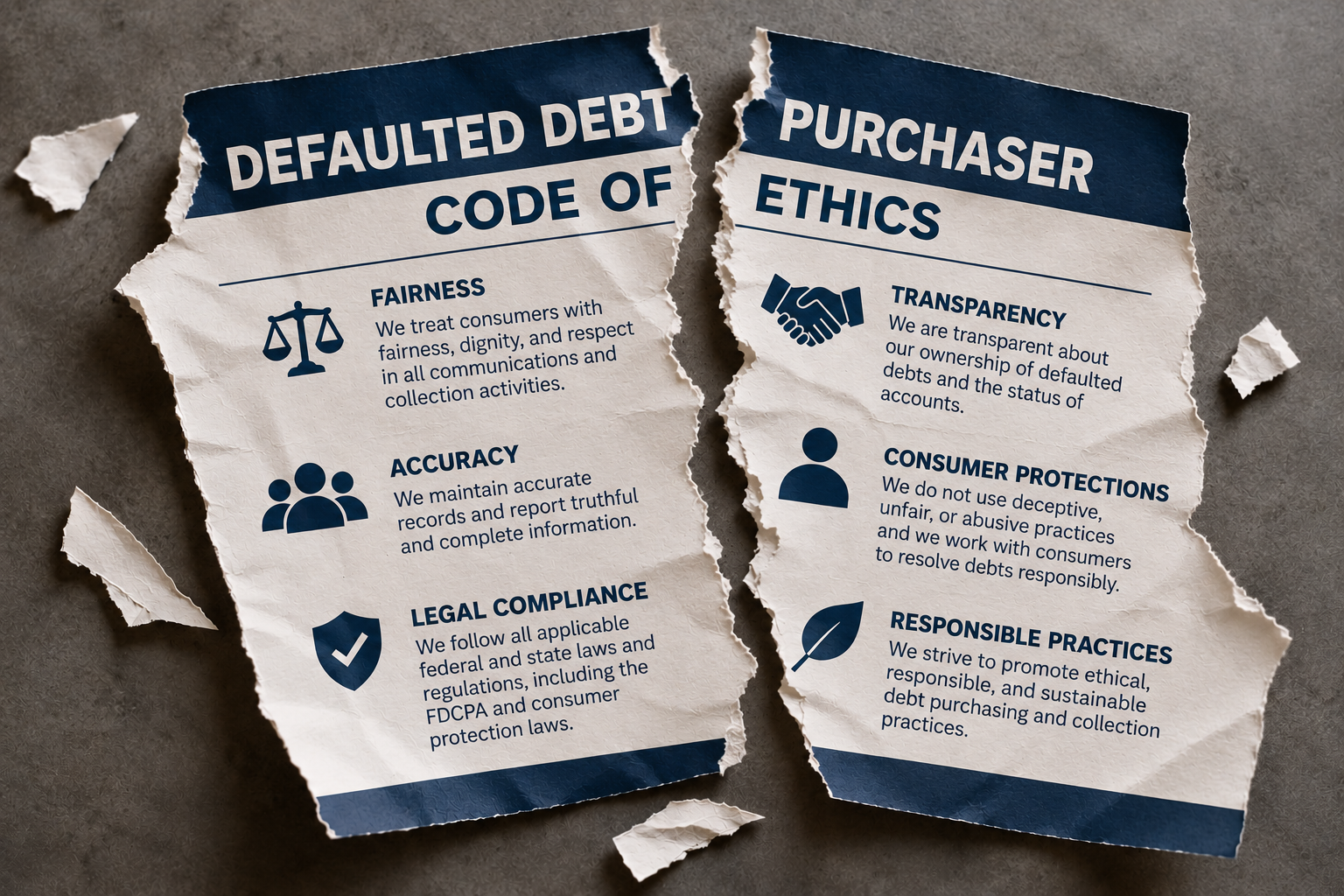
Many financial services companies publicly commit themselves to ethical conduct through corporate codes requiring compliance with applicable laws, reporting of misconduct, and internal accountability. But what happens when a company violates consumer protection laws and its employees or management fail to follow those same ethical commitments? In consumer litigation, the company’s failure to implement or enforce its own code of ethics may provide important evidence of its knowledge of misconduct, the adequacy of its compliance practices, and the credibility of its explanations for the conduct at issue. More than a decade ago, the Consumer Financial Protection Bureau explained that violations of consumer protection laws “cause significant financial injury to consumers, erode consumer confidence, and undermine fair competition in the financial marketplace.” And Congress explained one related purpose of the federal Fair Debt Collection Practices Act (“FDCPA”) was “to insure that those debt collectors who refrain from using abusive debt collection practices are not competitively disadvantaged…” 15 U.S.C.A. § 1692(e).
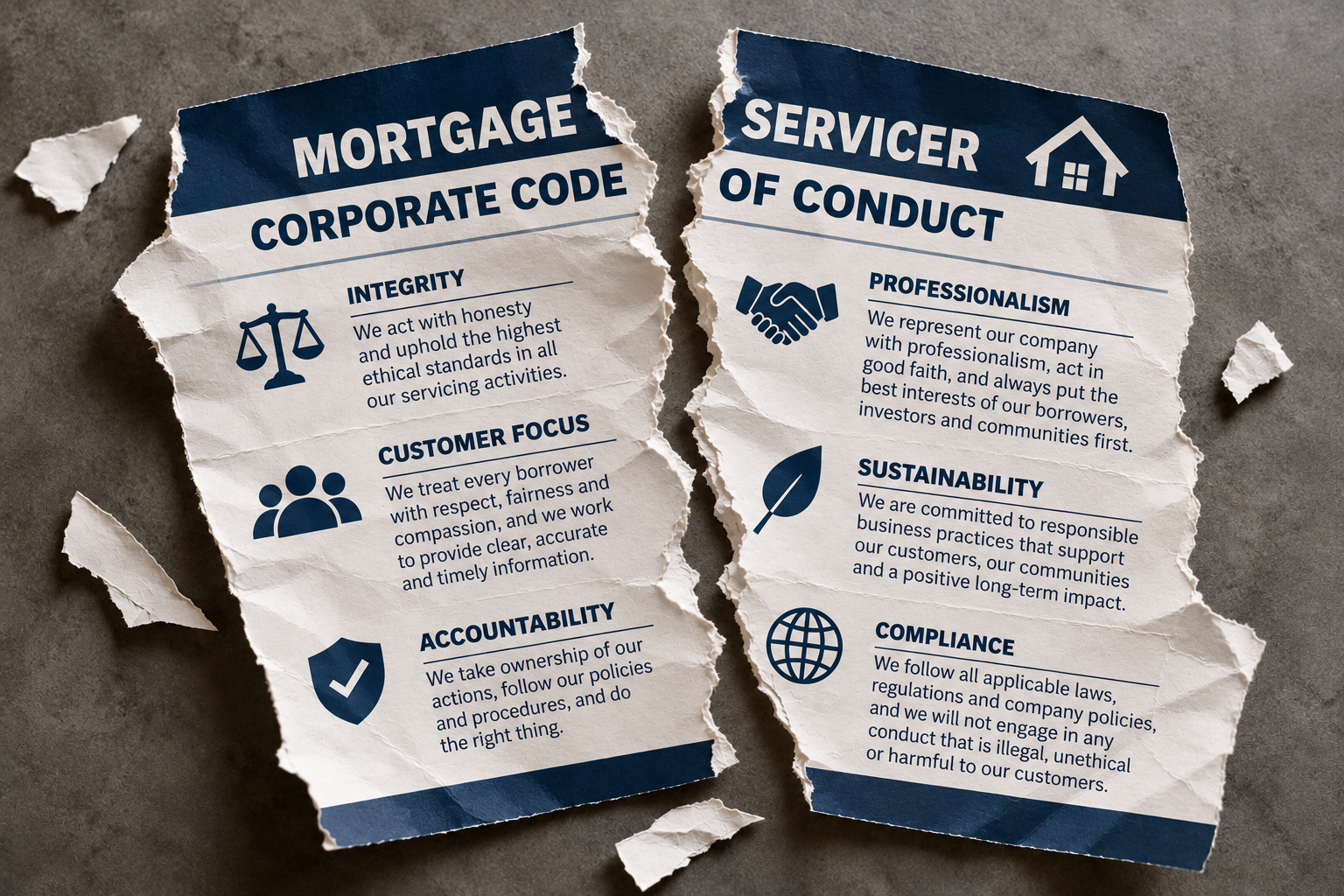
Generally, multi-layered corporations commonly create “a corporate business ethics policy applicable to all its subsidiaries.” Torres-Negron v. Merck & Co., Inc., 488 F.3d 34, 37 (1st Cir. 2007)(emphasis in original). For example, these financial service entities all have corporate codes of ethics and conduct: Equifax, the Rocket Companies (parent to Rocket Mortgage), Encore Capital Group (parent to Midland Funding LLC), Rithm Capital Corp (parent to NewRez LLC d/b/a Shellpoint) and Bank of America Corporation (parent to Bank of America, NA).
Regulations implementing the Sarbanes-Oxley Act explain that “the term code of ethics means written standards that are reasonably designed to deter wrongdoing and to promote…” compliance with all “applicable governmental laws, rules and regulations,” contain a meaningful process to report “violations of the code” up the chain of command at the business, and to employ a meaningful procedure to ensure the code is actually followed by the employees. 17 C.F.R. § 229.406(b). Separately, financial services regulators have imposed additional requirements for regulated entities to maintain policies, procedures, and compliance systems designed to ensure lawful treatment of consumers. See, e.g., 12 C.F.R. § 1024.38; Md. Code Regs. 09.03.06.26. And some regulators require a regulated financial service entity to “exercise a ‘duty of good faith and fair dealing in communications, transactions, and course of dealings with a [consumer] borrower’…[And] expects each licensee to know and comply with all [state] laws and regulations governing their activities…” Affidavit Testimony of Clifford K. Charland, Director of Operations at the Office of Financial Regulation in the Maryland Department of Labor and Past President of the American Association of Residential Mortgage Regulators (AARMR) (12/16/2024).
A company’s failure to follow its own code of ethics may provide evidence of a broader pattern or practice of misconduct, particularly when employees identify violations that management fails to investigate or correct. This evidence may be particularly significant when a company defends its conduct as an isolated mistake, inadvertent error, or good-faith interpretation of applicable law. Evidence that employees identified and reported misconduct, but management failed to investigate or correct it, may undermine those explanations and support an inference that the company knowingly tolerated the challenged practices. For example, some investigation and discovery in the litigation should be undertaken to determine:
- Did any employees report the company’s violations of the applicable law as required by the company’s code of ethics?
- Did employees or managers knowingly or recklessly fail to report suspected violations, and what does that failure reveal about the company’s compliance practices?
- Were any of the non-reporting employees disciplined pursuant to the requirements of the code of conduct and ethics?
- Did the company continue the challenged conduct after employees, managers, or compliance personnel identified it as potentially unlawful or inconsistent with the company’s code of conduct?
A corporation’s failure to report known violations of consumer protection laws, contrary to its code of ethics and conduct may constitute further evidence of the corporation’s knowing or reckless indifference to its unfair conduct in violation of a UDAP. A company’s disregard of its own ethical obligations may also disadvantage competitors that incur the costs of complying with applicable consumer protection laws and maintaining meaningful compliance systems. Congress recognized this concern in the FDCPA, identifying the prevention of competitive disadvantage to law-abiding debt collectors as one of the statute’s purposes. 15 U.S.C.A. § 1692(e).
Both Maryland and federal procedural rules permit discovery of information that may not ultimately be admissible at trial. Maryland Rule 2-402(a) permits discovery within its defined scope, including information reasonably calculated to lead to the discovery of admissible evidence. Federal Rule of Civil Procedure 26(b)(1) permits discovery of nonprivileged information relevant to a party’s claim or defense and proportional to the needs of the case. Thus, corporate codes of ethics, internal compliance procedures, and evidence concerning their implementation may be discoverable when relevant to the company’s challenged conduct or defenses. As explained by one Maryland court, “[i]t is not ground for objection that the information sought is already known to or otherwise obtainable by the party seeking discovery or that the information will be inadmissible at the trial if the information sought appears reasonably calculated to lead to the discovery of admissible evidence.” Trusted Sci. & Tech., Inc. v. Evancich, 262 Md. App. 621, 644–45, cert. denied, 489 Md. 253 (2024). And in litigation, “[a]ny party, including the party that called the witness, may attack the witness’s credibility.” Fed. R. Evid. 607. In the law the “credibility of the witness is always relevant in the search for truth.” Creekmore v. Crossno, 259 F.2d 697, 698 (10th Cir. 1958)(cleaned up). To this end, as recognized by the leading treatise on civil practice, “discovery is commonly allowed in which the discovering party seeks information with which to impeach witnesses for the opposition.” § 2015 Matters Useful for Impeachment, 8 Fed. Prac. & Proc. Civ. § 2015 (3d ed.). Whether the information learned in discovery is relevant for admission at a later stage of the proceedings for impeachment or direct evidence is a different question.
In consumer litigation involving a corporation’s violation of the law or governing loan terms, corporate policies and compliance failures may be discoverable when relevant to disputed claims or defenses. Not every policy violation is necessarily admissible impeachment evidence. Such evidence may show background facts which bear directly on whether the factfinder should credit the company’s witnesses and explanations for the challenged conduct.
Courts have recognized the potential significance of discrepancies between a corporation’s public ethical commitments and its actual practices. In re Signet Jewelers Ltd. Securities Litigation, No. 16 Civ. 6728, 2019 WL 2656338 (S.D.N.Y. June 20, 2019), the court rejected the defendants’ contention that statements in the company’s code of conduct were necessarily inactionable puffery where the complaint contained detailed allegations contradicting those statements. Although the case involved securities litigation rather than consumer protection claims, it illustrates why a corporation’s stated ethical commitments should not automatically be dismissed as irrelevant when evidence suggests materially inconsistent conduct. The case law also shows numerous instances of financial service actors utilizing their codes of ethics and conduct themselves to advance their own claims or affirmative defenses. See, e.g. Sako v. Wells Fargo Bank. N.A., No. 14CV1034-GPC(JMA), 2016 WL 110513, at *1 (S.D. Cal. Jan. 8, 2016)(Wells Fargo argued that a former employee was not entitled to certain compensation because it claimed the employee violated its Code of Ethics and Business Conduct). Although a corporation’s violation of its own code of ethics does not necessarily establish an independent violation of consumer protection law, evidence of that violation may be relevant to whether the corporation knowingly engaged in, tolerated, or failed to correct unlawful practices.
Consumer protection attorneys who rely exclusively on a corporate designee’s testimony may overlook important opportunities to test the company’s explanations. Discovery from employees who participated in the challenged conduct, received complaints, or were responsible for reporting violations may reveal facts inconsistent with the corporation’s official position. Such evidence may be especially important when the corporate designee lacks firsthand knowledge of the events at issue. “A corporation is a creation of state law and can act only through its agents—that is, its employees, officers or authorized representatives.” 4 Modern Federal Jury Instructions-¶ 72-2 (Corporate Responsibility). Thus, counsel should test the company’s explanations not only through its designated representative but also through employees directly involved in the challenged conduct.
So, if the financial service company defendant claims to live by a corporate code of conduct and ethics, consumer protection attorneys should investigate whether the company’s actual practices are consistent with its published code. Relevant questions include:
- Does the company train its employees to implement its code of conduct?
- Does the company track and investigate reported violations of applicable law and its code of conduct?
- Does the company maintain quality-control procedures to ensure that violations are identified, investigated, and corrected?
- Did management investigate the reported misconduct at issue in this dispute?
The answers may reveal evidence that the misconduct was not isolated and that the company knowingly tolerated or failed to correct practices inconsistent with its stated ethical obligations.
Consumer protection attorneys should not simply accept a corporate defendant’s assertion that it follows its published code of ethics. They should test that assertion through discovery of employee training, internal reporting, compliance investigations, management responses, and corrective actions. When a company publicly promises to comply with applicable laws but fails to investigate or correct known violations, that discrepancy may provide evidence of its knowledge, corporate practices, and credibility.
A corporate code of ethics should be more than a public declaration of corporate values. In consumer protection litigation, it can provide an important standard against which the company’s actual conduct—and its explanations for that conduct—can be tested.
Recent Comments